

Blog
Compression Socks During Pregnancy: Are They Safe and What Do OBs Recommend?

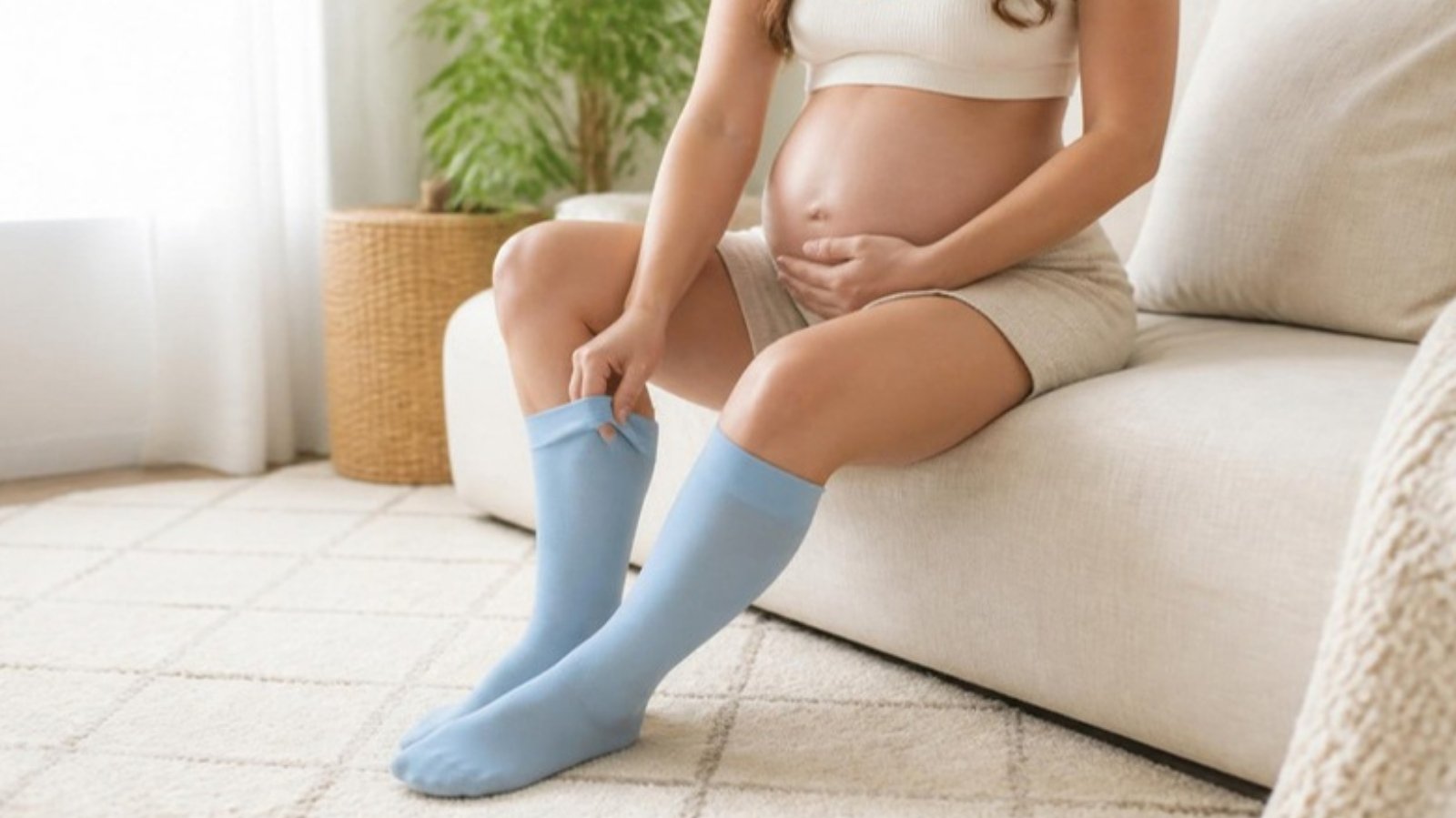
Yes — for most healthy pregnancies, wearing compression socks during pregnancy is considered safe, and OB-GYNs and midwives commonly suggest them for leg swelling, heavy or achy legs, varicose veins and long trips. The safest choice is a well-fitted, graduated, knee-high sock in a light to moderate range (about 15–20 mmHg for everyday wear), with firmer 20–30 mmHg pairs used when your OB or midwife suggests them. There is no single brand that “all OBs recommend”; what clinicians look for is the right pressure level, correct sizing and a smooth, comfortable fit — and a quick check with your own provider first if you have any circulation, skin or nerve problems.
This guide explains what “safe” really means for maternity compression socks, what pressure levels clinicians typically suggest, who should get personal advice before wearing them, and how to choose and wear a pair so they actually help.
Quick answer: what OBs usually recommend
When pregnant patients ask about compression, the advice from obstetric and vascular sources tends to follow the same few rules:
- Graduated compression. Pressure should be firmest at the ankle and ease off toward the knee, which helps blood move back up the leg instead of pooling.
- Knee-high length for most people. Knee-highs are easier to put on over a growing bump and are the length most often suggested for everyday swelling and travel. Thigh-highs or maternity pantyhose are usually reserved for varicose veins above the knee, on a clinician’s advice.
- Light to moderate pressure. Around 15–20 mmHg is the common starting point for daily comfort. One board-certified OB-GYN interviewed by Pediatrix Medical Group suggests knee-high socks rated 20–30 mmHg, while stressing that they should feel neither too loose nor too tight. UK NHS hosiery guidance lists varicose veins in pregnancy as a reason to use light or medium support, chosen by severity and how well you tolerate it.
- A proper fit. Measuring your ankle and calf — ideally in the morning before swelling builds — matters more than the brand name on the package.
- A check-in when something is unusual. Sudden swelling, swelling in only one leg, or pain and warmth in a calf are not “sock problems.” They need a call to your provider.
Are compression socks safe during pregnancy?
For most people, yes. Graduated compression works from the outside of the leg and does not involve any medication, so there is nothing that crosses to the baby. The main risks come from the wrong fit or the wrong person wearing them: socks that are too tight, that roll down into a tight band, or that are worn by someone whose arteries, nerves or skin cannot tolerate pressure.
It also helps to be realistic about the evidence. A 2015 Cochrane review of treatments for varicose veins and leg swelling in pregnancy found only seven small trials (326 women in total) and concluded there was not enough evidence to say firmly which treatments work best; the one small compression trial it included did not show a clear difference in lower-leg volume compared with rest. A later randomized trial in Brazil (60 pregnant women) gave knee-high 20–30 mmHg stockings for about eight hours a day from the first trimester into the third. Ankle and calf measurements increased much less in the stocking group than in the control group, every woman wearing them reported noticing a difference in her legs, and all said they would wear them again — although about a third found them somewhat difficult to wear, and one in five needed help putting them on.
So the honest summary is: compression socks are low-risk for most pregnant people, many find them very comfortable, and smaller studies suggest they can limit day-to-day swelling. They are a comfort and circulation-support tool, not a treatment for any medical condition, and they do not replace prenatal care.
Why legs swell and veins change in pregnancy
Understanding what is going on in your legs makes it easier to see where compression fits.
- Extra fluid. Your body holds more water during pregnancy, and gravity pulls it to the lowest points — feet, ankles and lower legs. Swelling is often worse at the end of the day, in hot weather and later in pregnancy.
- Pressure from the uterus. As the uterus grows, it presses on the large veins that carry blood back from the legs, slowing return flow.
- Hormonal changes. Pregnancy hormones relax the walls of blood vessels, which can make veins more prone to stretching and varicose veins.
- Higher clot risk. The CDC notes that pregnancy raises the risk of blood clots (venous thromboembolism) about fivefold, and that the risk stays elevated through childbirth and for about three months after delivery. Long periods of sitting still add to that risk.
Graduated compression gently squeezes the lower leg so that veins and surrounding tissue have less room to let fluid pool. That is why many people notice lighter, less puffy legs by evening.
Who should talk to their OB or midwife first
Compression is not right for everyone. UK NHS prescribing guidance for compression hosiery and anti-embolism stockings lists several situations where stockings should not be used, or only after a clinical assessment. Talk to your OB, midwife or doctor before buying a pair if any of these apply to you:
- Peripheral arterial disease (PAD) or poor arterial circulation — signs can include leg pain when walking that eases with rest, a cold foot, or weak pulses in the foot.
- Peripheral neuropathy or reduced feeling in your feet, for example from diabetes, because you may not notice if the socks are too tight.
- Fragile skin, dermatitis, open wounds or a recent skin graft on your legs.
- Very severe swelling, or legs with an unusual size or shape where a standard sock cannot fit evenly.
- A known allergy to the sock material (latex or certain synthetic fibers).
- A previous blood clot, a clotting disorder, or current blood-thinning treatment. Compression may still be part of your plan, but your care team should choose the type and level.
If you are already under the care of a maternal-fetal medicine specialist or a vascular clinic, follow their specific instructions on compression class and length.
Warning signs that need medical attention — not compression
Some kinds of swelling are a reason to call your provider right away instead of reaching for socks:
- Sudden swelling of your face, hands or feet, especially with a severe headache, vision changes (blurring or flashing lights), pain just below the ribs, or feeling very unwell. The NHS lists these as possible signs of pre-eclampsia that need urgent assessment.
- Swelling in only one leg, especially with pain or tenderness, warmth, or red or discolored skin. These can be signs of a deep vein thrombosis (DVT).
- Shortness of breath, chest pain that worsens when you breathe in or cough, a fast or irregular heartbeat, or coughing up blood. The CDC advises emergency care for these possible signs of a pulmonary embolism.
Compression socks should never be used to “treat” any of these symptoms at home.
Compression levels explained: which mmHg is safest?
Compression strength is measured in millimeters of mercury (mmHg) at the ankle. Higher numbers mean firmer pressure. Here is how the common over-the-counter ranges usually line up with pregnancy needs:
| Compression level | How it feels | Typical pregnancy use | Who usually chooses it |
|---|---|---|---|
| 8–15 mmHg (light) | Gentle, like a snug sock | Mild end-of-day puffiness, first-time wearers | Anyone who finds firmer socks hard to tolerate |
| 15–20 mmHg (moderate) | Noticeable but comfortable hug | Everyday swelling, long days on your feet, shorter trips | The most common starting point for pregnancy |
| 20–30 mmHg (firm) | Firm, takes more effort to put on | Heavier swelling, visible varicose veins, long flights or drives | Often used when an OB or midwife suggests it |
| 30–40 mmHg and above (extra firm) | Very firm, medical hosiery | Specific vein or clot-related conditions | Only when prescribed and fitted by a clinician |
Two practical points:
- Start lower if you are unsure. A 15–20 mmHg sock you actually wear every day helps more than a 20–30 mmHg pair that stays in the drawer because it is uncomfortable.
- Labels are not all equal. Over-the-counter compression socks are not individually measured the way prescription hosiery is, so treat the mmHg rating as a guide and pay close attention to the size chart.
How to choose safe maternity compression socks
1. Pick graduated, knee-high socks
Graduated means the pressure decreases from ankle to knee. Avoid socks that feel tightest at the top band, because a tight band behind the knee can act like a tourniquet.
2. Measure — do not guess your size
Most size charts use ankle circumference (just above the ankle bone) and calf circumference (at the widest part). Measure in the morning, before swelling builds, and re-measure as your pregnancy progresses. If your calf is near the top of a size or your legs are fuller, a wide-calf design will usually spread pressure more evenly.
3. Check the top band and the heel
A wide, soft top band is less likely to dig in or roll down. A shaped heel keeps the sock aligned so the pressure zones sit where they should.
4. Choose breathable, smooth fabrics
Nylon–spandex blends are durable and keep their stretch; cotton or bamboo-viscose blends can feel softer and cooler. Smooth or flat seams reduce rubbing, which matters if your skin is more sensitive in pregnancy.
5. Look for clear labeling
A trustworthy listing states the mmHg range, the sizing measurements and the fiber content. Be cautious with vague wording such as “medical strength” with no pressure range, or promises to cure or prevent any condition.
How to wear compression socks safely during pregnancy
- Put them on in the morning, ideally soon after getting up, while your legs are least swollen.
- Use the inside-out method. Turn the sock inside out down to the heel, slip your foot in, then roll and smooth it up the leg. Sitting down makes this much easier once your bump grows.
- Smooth out wrinkles. Creases and bunched fabric create pressure lines. Never leave the sock rolled down into a band.
- Take them off at night unless your provider tells you otherwise. Compression works with gravity when you are upright; most people do not need it while lying down.
- Check your skin daily when you take them off — look for red marks that do not fade, blisters or broken skin.
- Stop and call your provider if you notice pain, numbness, pins and needles, cold or blue-tinged toes, or new skin discoloration while wearing them.
- Replace worn pairs. Compression fabric loses elasticity with washing and wear. Having two or three pairs lets you rotate and wash them, usually in cool water and air-dried.
Compression works best alongside simple habits: walking, ankle circles and calf raises during the day, putting your feet up when you can, drinking water, and avoiding long stretches of standing still.
Compression socks for travel during pregnancy
Long journeys combine two things that raise clot risk: pregnancy and sitting still. The NHS notes that flights over four hours carry a small risk of blood clots and suggests drinking water and moving about every 30 minutes or so; it also says graduated compression or support stockings from a pharmacy will help reduce leg swelling, and that compression stockings can help prevent blood clots on car journeys of more than four hours.
For travel, many people step up from their everyday 15–20 mmHg pair to a firmer 20–30 mmHg pair — ideally after checking with their OB or midwife, especially if they have any extra clot risk factors. Put them on before you leave, wear them for the whole journey, and keep moving whenever you safely can.
Compression socks we carry for pregnancy
If you are ready to shop, these three styles from our maternity range cover the most common needs. All are knee-high, sold by size, and best chosen with the measurements above. Prices and color options change, so check the product page for current details.
Everyday comfort: 15–20 mmHg knee-high socks
Our Medical Compression Socks for Swollen Ankles Pregnancy Support 15–20 mmHg are a moderate, graduated knee-high in a nylon, polyester and spandex knit with a reinforced heel and smooth stitching. They come in S/M and L/XL and several colors with a grid pattern. This is the level most people start with for daily swelling and long days on their feet.
Travel days: 20–30 mmHg cotton-blend socks
For flights, road trips and long periods of sitting, our 20–30 mmHg compression socks for pregnancy travel offer firmer graduated support in a cotton–nylon blend with a stay-up design. They come in S-M and L-XL in black, red or white. Because they are firmer, they are a good option to raise with your OB or midwife before a long trip.
Fuller calves: wide-calf 20–30 mmHg socks
If standard socks dig in at the calf, the Plus Size Compression Socks for Pregnancy Wide Calf Knee High 20–30 mmHg use a breathable polyester knit with extra calf stretch, in sizes XXL to 5XL and single or three-pair packs. A wider fit helps keep pressure even rather than concentrated in one tight spot.
You can compare every option, including different colors and pack sizes, in our full maternity compression sock collection. If swollen ankles are your main concern, our guide to choosing compression socks for pregnancy swelling goes deeper into fit and fabric for that specific problem.
When to start and how long to wear them
There is no set week when you must start. Many people begin when they first notice swelling, heaviness or visible veins — often in the second or third trimester — while others start earlier if they stand for work, travel often or had varicose veins in a previous pregnancy. In the Brazilian trial mentioned above, women started in the first trimester and wore knee-high stockings for about eight hours a day.
A practical routine for most people is to wear them during the day while you are upright and active, take them off at night, and keep going as long as they help. Many people continue in the weeks after birth, when clot risk stays raised; ask your provider what they recommend for your recovery, especially after a cesarean birth.
Frequently asked questions
Can I sleep in compression socks while pregnant?
Most people do not need to. Everyday compression socks are designed for when you are upright and gravity pulls fluid down. Unless your provider has prescribed overnight wear, take them off at bedtime and let your skin breathe.
Is 20–30 mmHg too strong during pregnancy?
Not necessarily. It is a firm, widely used level, and some OBs suggest it for swelling and varicose veins. It can be harder to put on and may feel too tight for some people, so 15–20 mmHg is a sensible starting point unless your provider advises otherwise. Levels of 30 mmHg and above are normally prescription hosiery.
Do I need a prescription for maternity compression socks?
Not for over-the-counter levels up to about 20–30 mmHg. Higher levels and custom-fitted hosiery are usually ordered through a clinician.
Can compression socks cause blood clots?
Correctly fitted graduated compression is used to support circulation, not to restrict it. Problems usually come from socks that are too small, roll down or bunch into a tight band. If you already have a clot or suspect one, do not put on compression socks without medical advice.
Are compression socks safe in the first trimester?
Yes, for most people. Compression acts only on the outside of the legs, so it is not linked to any particular stage of pregnancy. Some people simply do not need them until swelling or heaviness appears later on.
The bottom line
Compression socks during pregnancy are a simple, low-risk way for most people to ease swelling, tired legs and the discomfort of varicose veins. The “safest” pair is not a particular brand — it is a graduated, knee-high sock at a level you can wear comfortably (usually 15–20 mmHg, or 20–30 mmHg on your provider’s advice), sized from your own measurements and worn correctly. Check with your OB or midwife first if you have circulation, nerve or skin problems, and call them right away for sudden, one-sided or painful swelling.
References
- Interventions for varicose veins and leg oedema in pregnancy. Cochrane Database of Systematic Reviews, 2015 (CD001066). https://www.cochrane.org/CD001066/PREG_interventions-for-varicose-veins-and-leg-oedema-in-pregnancy
- Positive perception and efficacy of compression stockings for prevention of lower limb edema in pregnant women. Jornal Vascular Brasileiro, 2022. https://pmc.ncbi.nlm.nih.gov/articles/PMC8958436/
- Centers for Disease Control and Prevention. Pregnancy and blood clots. https://www.cdc.gov/blood-clots/risk-factors/pregnancy.html
- NHS. Swollen ankles, feet and fingers in pregnancy. https://www.nhs.uk/pregnancy/related-conditions/common-symptoms/swollen-ankles-feet-and-fingers/
- NHS. Travelling in pregnancy. https://www.nhs.uk/pregnancy/keeping-well/travelling/
- Derbyshire Medicines Management (NHS). Compression hosiery prescribing guideline. https://app.derbyshiremedicinesmanagement.nhs.uk/assets/Clinical_Guidelines/Formulary_by_BNF_chapter_prescribing_guidelines/Appendix_5/Compression_hosiery.pdf
- Sherwood Forest Hospitals NHS Foundation Trust. Anti-embolism (TED) stockings patient leaflet. https://sfh-tr.nhs.uk/media/bcadbbek/pil202403-03-ted-ted-stockings.pdf
- Pediatrix Medical Group. Compression socks for pregnancy (OB-GYN interview). https://www.pediatrix.com/about/for-media/news/compression-socks-for-pregnancy