
Blog
Breastfeeding Maxi Dress Features and Styling Guide

You're holding a baby in one arm, trying to keep your shirt in place with the other, and realizing the dress you picked looked great before delivery but works against you now. The neckline slips, the fabric grabs at your midsection, and feeding in public feels more exposed than it should. That's exactly where a breastfeeding maxi dress earns its place, because the right design has to do two jobs at once, support nursing access and still flatter a postpartum body that's changing week by week.
Table of Contents
- Why Breastfeeding Maxi Dresses Matter for New Moms
- How Breastfeeding Maxi Dress Access Systems Work
- Best Fabrics for Breastfeeding Maxi Dresses
- Finding the Right Fit After Pregnancy
- Styling Maxi Dresses for Every Occasion
- Travel and Heat Styling Examples
- Choosing Your Breastfeeding Maxi Dress with Confidence
Why Breastfeeding Maxi Dresses Matter for New Moms
A new mom often discovers the problem at the worst possible moment, during a family dinner, a doctor's waiting room, or a hot afternoon out with the stroller. The dress that seemed easy enough when she bought it suddenly asks for too much, too much pulling, too much exposure, too much fabric bunched around the bust while the baby is already upset. A good breastfeeding maxi dress removes that friction by making feeding easier without forcing a full outfit change.
That practical need isn't niche. The global breastfeeding-clothes market was valued at USD 1.5 billion in 2024 and is forecast to reach USD 2.8 billion by 2033, with a 7.5% CAGR from 2026 to 2033 according to Verified Market Reports. The same source notes that about 84% of infants are breastfed at birth in the U.S., which helps explain why nursing-friendly clothing keeps expanding beyond basic tops and into dresses that work for errands, events, and everyday wear.
The real job the dress has to do
The best version doesn't just open for feeding. It lets a mom settle the baby quickly, keeps the bust supported, and avoids the awkward sequence of lifting, twisting, and half-undressing that makes nursing feel like a public performance. That matters more after delivery, when comfort, speed, and discretion all matter at the same time.
Practical rule: if a dress only looks nursing-friendly in product photos, but makes you expose your whole torso to feed, it's not actually solving the problem.
A maxi dress is popular because it already gives coverage, but coverage alone doesn't make it functional. The nursing-specific details are what turn it into clothing you can wear repeatedly, especially in the weeks when you're leaving the house more often but still want softness, ease, and a little dignity during feeds.
How Breastfeeding Maxi Dress Access Systems Work
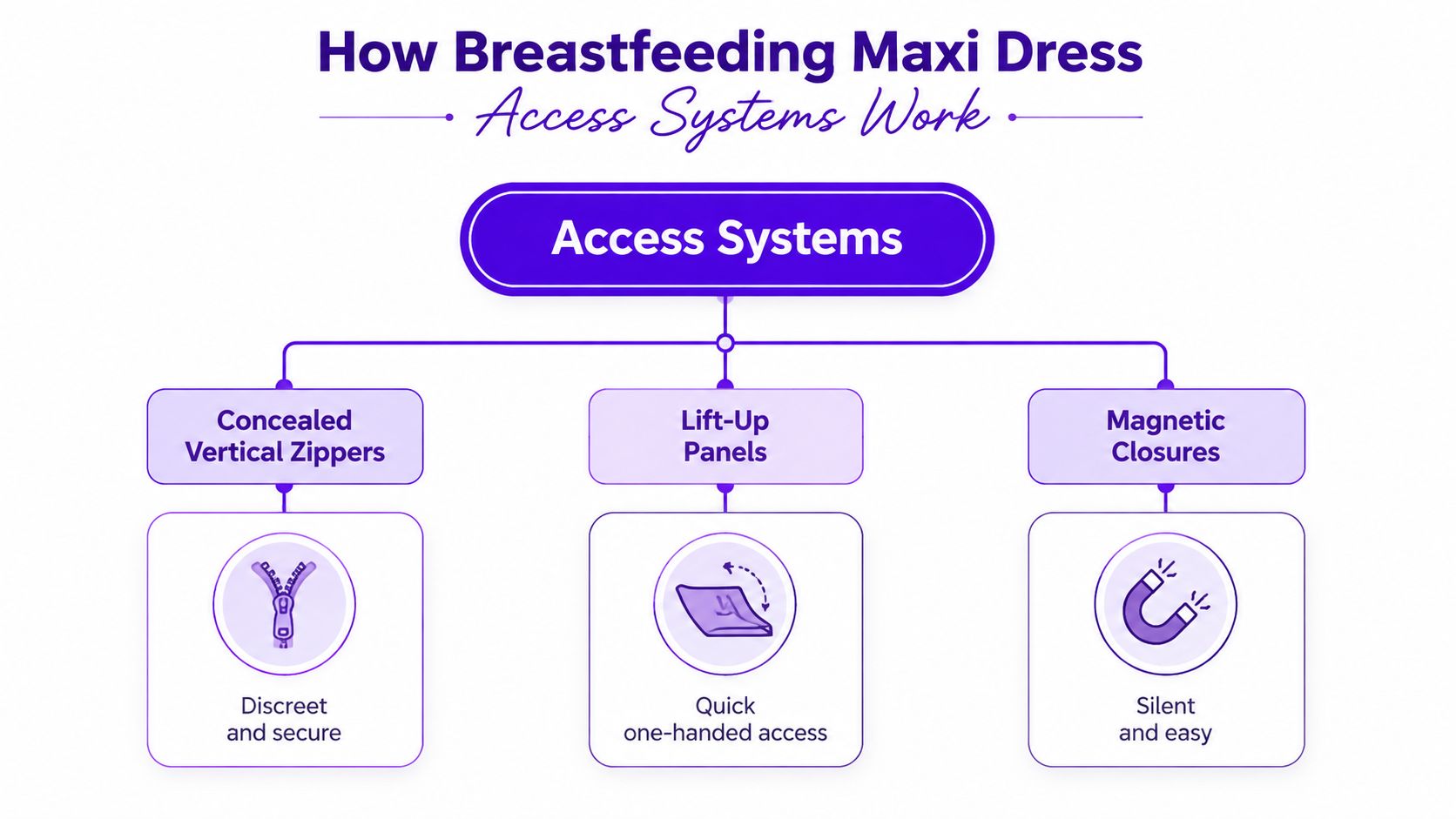
The easiest way to understand a breastfeeding maxi dress is to look at how the front opens. Good access systems reduce the amount of garment you need to move, while keeping the dress anchored around the shoulders, bust, and waist. That balance is the difference between a dress that stays on your body and a dress that becomes a puzzle every time the baby roots for milk.
Concealed zippers and what they change
Hidden vertical zippers are common in nursing maxi designs because they open a specific feeding path without asking you to remove the whole dress. Product examples use hidden side zippers disguised as bust darts or double bust zips, and the point is simple, preserve shape while creating one-hand feeding access. Designs like these are meant to reduce exposure and help with quicker latch positioning during public or on-the-go feeding, which is exactly where many moms feel most self-conscious.
The trade-off is that zippers can feel more structured and less airy than soft overlay systems. They're discreet when closed, but they depend on good placement. If the zipper sits too far from the bust point or the surrounding fabric is stiff, the opening may be technically functional but annoying in real use.
Lift-up overlays and why they feel different
Lift-up panels work by layering fabric so you can raise one section and nurse underneath. That makes the motion simple, especially with one hand, and the access often feels faster when you're holding a baby who doesn't wait patiently. The downside is visible fabric movement, which can matter if you're nursing in a crowded restaurant or on a plane.
Short version: zippers hide better when closed, lift-up panels can feel quicker in the moment.
What to check before you buy
- Access placement: Make sure the opening lines up with your bust, not just the center of the chest.
- Support structure: Look for built-in shaping, because a loose opening without support can sag.
- Public comfort: Ask whether you can feed without fully exposing your midriff.
- Latch speed: Test whether one hand can reach the opening smoothly while the other supports the baby.
The best access system is the one that matches your routine. If you like a neater finish, concealed zippers may feel safer. If you need fast, low-fuss feeding at home or while traveling, a lift-up layer can be more forgiving.
Best Fabrics for Breastfeeding Maxi Dresses
Fabric choice is not a side detail in postpartum clothing, it often decides whether a dress feels useful or frustrating. In maternity dress shopping research, 96.3% of women said fabric is a vital factor, and 48.3% gave fabric the maximum priority score of 10 out of 10 in a survey published by The Print. The same survey found 95.3% preferred cotton as their go-to maternity-dress fabric. That matches the reality of a breastfeeding dress, which sits close to skin, gets washed often, and has to stay comfortable through long wear and repeated feeding.
A quick fabric comparison
| Factor | Percentage |
|---|---|
| Women who said fabric is a vital factor | 96.3% |
| Women who gave fabric a 10 out of 10 priority score | 48.3% |
| Women who preferred cotton | 95.3% |
Cotton stays popular for a reason. It feels familiar, breathes well, and is easy to wear for long stretches. Viscose rayon and linen also appear in the survey as preferred choices, and that makes sense for nursing dresses because both can feel lighter than dense knits while still draping better than clingy jersey.
The Functional Purpose of the Dress
A thin jersey dress may feel soft at first, but it can cling to a softer midsection and draw attention to the nursing point. A more structured weave can help the dress skim the body instead of sticking to it, which is useful if you want the dress to look polished after feeding, not just before it.
Practical rule: choose fabric with two questions in mind, does it breathe, and does it still look decent after repeated access and repeated washing?
Plus-size shoppers need to be especially selective. A fabric that stretches too much can outline every movement, while a fabric that is too rigid can make access harder and the dress less forgiving across the bust. The best middle ground is softness with enough shape to keep the silhouette calm. For a broader sense of post-birth dressing priorities, see this plus-size postpartum clothing guide.
A breathable maxi dress also helps when you are feeding in warm rooms, in the car, or after walking outside with a baby. When the fabric does its job, you spend less time adjusting the garment and more time feeding.
Finding the Right Fit After Pregnancy
A lot of shopping advice treats maternity dresses and nursing dresses as if they're the same thing. They're not. Guidance linked by Women's Health says maternity dresses are built to fit a bump, while nursing dresses are adapted for breastfeeding access, and many maternity styles fit worse postnatally, which matters when you're dressing a softer midsection, a wider ribcage, and a bust that may fluctuate through the day.
That distinction is especially important for plus-size bodies. A dress that looked flattering over a bump can feel too straight through the torso after delivery, or it can pull across the chest because the bust has changed shape while the waist has not gone back to anything like its previous size. For a useful reference on recovery dressing, see this plus-size postpartum clothing guide.
Silhouettes that usually work better
Wrap fronts are useful because they create a visual line that crosses the body instead of stopping at the widest point. Flexible waistlines can sit higher or lower depending on where your body feels most comfortable that day, and elastic gathers can ease over a belly without making the dress look boxy.
Deep access panels are helpful too, but only if they're paired with enough body-skimming shape to keep the dress from hanging like a tent. A lot of shoppers want the hidden benefit of nursing access without looking dressed for a medical appointment, and silhouette does a lot of that work.
Fit check: if the dress only flatters while standing still, it probably won't feel right when you're carrying a baby, bending over, or nursing seated.
A postpartum fit checklist
- Bust room: There should be enough ease for a changing bust without flattening the chest.
- Midsection coverage: The skirt should skim, not cling, over the lower belly.
- Waist placement: Flexible placement is better than a fixed seam that sits at the wrong spot.
- Movement test: Sit, lift your arms, and mimic a feeding position before you commit.
- Public discretion: Make sure the nursing opening doesn't expose more than you're comfortable with.
The point is not to chase a “pre-baby” silhouette. The point is to find a dress that respects your body as it is now, especially if you want something you can wear more than once without feeling squeezed or exposed.
Styling Maxi Dresses for Every Occasion
A breastfeeding dress earns its keep when it stops being a special-occasion item and starts acting like a wardrobe anchor. One mom might wear it to a baby shower, then to a park walk the next week, then again for a dinner where she wants to look put together without wearing anything complicated. That's the appeal of the maxi length, it can read soft, polished, and practical all at once.
The easiest styling move is to let the dress do the heavy lifting and keep everything else simple. A cardigan can add modesty for feeding in public, flat sandals make walking easier, and a layered necklace can draw the eye upward so the outfit feels intentional instead of purely functional. Browse more silhouettes in the dress collection to see how different cuts change the overall mood.
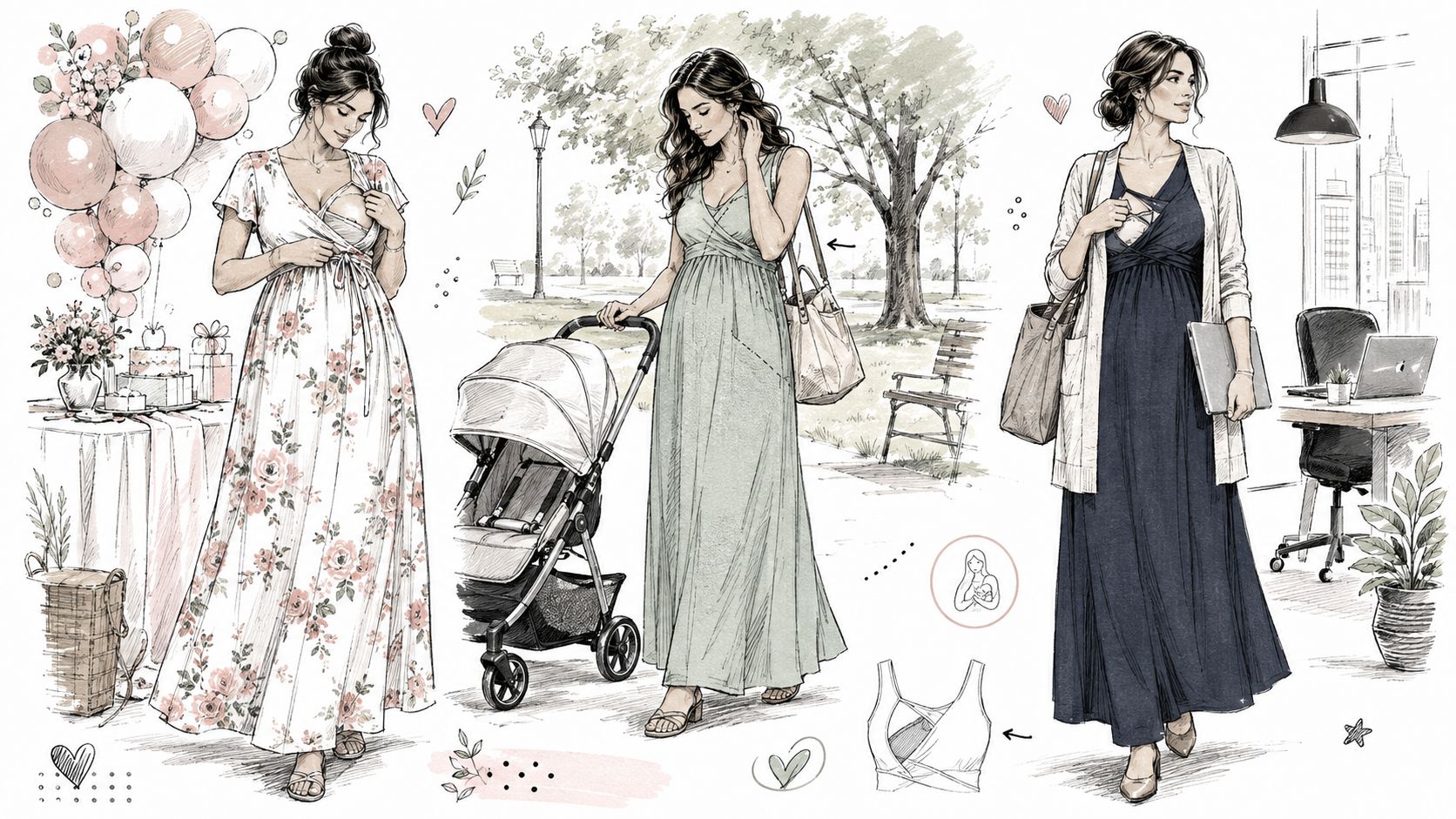
Four moments where it works well
Baby showers. A flowing print with a defined waist looks festive without feeling fussy. If the dress has nursing access built in, you can keep the same outfit on for the event and the feed afterward.
Park walks. Lightweight fabric and flat shoes matter more here than decoration. The dress should move with you, not drag or twist when you're pushing a stroller.
Work-adjacent outings. A simple jacket can make the same dress feel sharper. A cleaner neckline and a more structured fabric usually help.
Evening events. Longer earrings or a neat hairline can enhance the whole look without interfering with feeding access. The dress still has to function, but it doesn't have to look purely utilitarian.
A maxi dress becomes most useful when its style range is broad. If it can shift from daytime to evening with a change of shoes or layer, it earns far more wear than a one-note nursing piece.
Travel and Heat Styling Examples
Travel exposes weak design fast. A dress that seems fine at home can turn annoying on a flight, in a hot car, or after a long day of errands, because you're feeding more often, changing positions more often, and dealing with more humidity than usual. That's where the trade-off between hidden zippers and lift-up panels becomes practical, not theoretical.
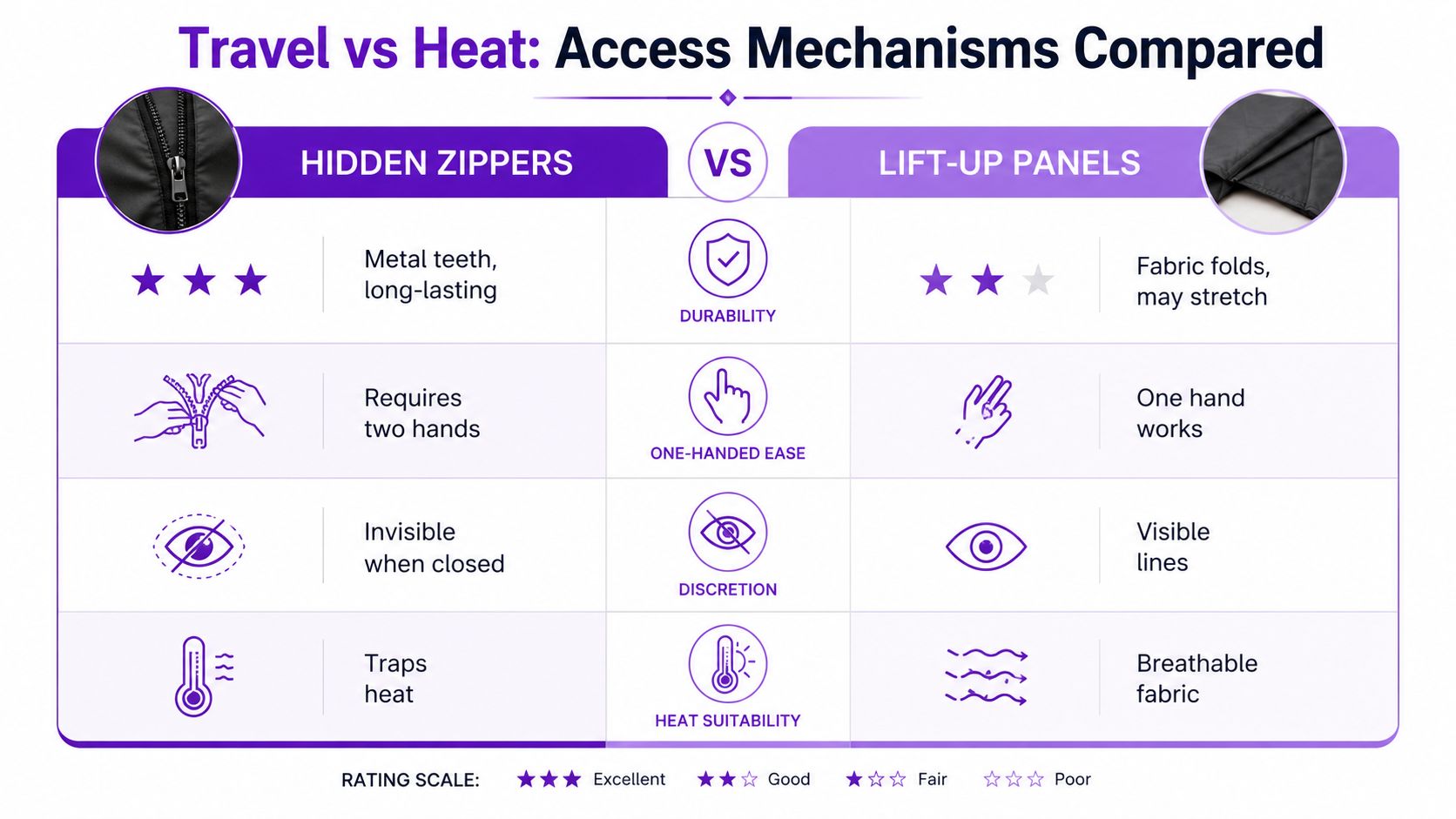
What changes with repeated use
Hidden zippers tend to feel more secure and stay discreet when closed, which helps on flights or in public settings where you want the dress to look tidy. Product guidance and creator discussions about converting regular dresses with invisible zippers also point to a demand for more flexible, low-cost solutions, especially when shoppers want nursing access without buying something that looks obviously medical or maternity-specific.
Lift-up panels feel easier with one hand, which matters when you're holding a baby, a bag, or a coffee. They're also usually better for heat because they rely on fabric movement rather than hardware, though they can show visible lines and may stretch with heavy use.
Side-by-side thinking for real scenarios
- Long travel days: Hidden zippers can feel more secure, but they may trap more heat and can be slower if you need repeated feeds.
- Hot weather: Lift-up panels usually breathe better, but they can feel less polished if the fabric is thin.
- High-frequency nursing: One-handed access matters more than appearance once you're feeding several times in a day.
- Repeated washing: Hardware and seams should be checked for wear, because the dress has to survive more than one season of use.
For plus-size users, thin jersey on a hot day can cling and reveal the nursing point, which makes discretion harder. A slightly more stable fabric with a reliable access opening usually feels better than a dress that looks breezy but behaves unpredictably once the baby is in your arms.
The smartest choice for travel and heat is the one that matches your actual routine. If you fly often or move through multiple feeds in a day, prioritize access that still works when you're tired, warm, and not in front of a mirror.
Choosing Your Breastfeeding Maxi Dress with Confidence
Start with the opening before you think about color or print. A breastfeeding maxi dress has to let you feed without fumbling, especially on days when one hand is already full. After that, check the fabric, because breathability and stretch decide whether the dress feels good in a warm room, in the car, or during a long outing. Then look at the silhouette, especially if you want room for a postpartum belly, a changing bust, and the weight shifts that come with recovery.
A lot of shoppers get stuck between “pretty” and “practical,” but the right dress can handle both if the details are built for real life. The test is whether you can move through a normal day, feed in public, and still feel like yourself when you catch your reflection. For more guidance on fit, access, and everyday wear, see our guide on how to choose plus-size nursing clothes for effortless breastfeeding and everyday style.
Bottom line: the right dress supports bonding, not just clothing. It should make feeding easier, not add another layer of decision fatigue.
If you want something you can wear through errands, outings, and the long middle stretch of postpartum life, compare how the opening works first, then how the fabric feels, then how the shape sits on your body. That order keeps the choice tied to your actual routine, not just a cute photo.
A plus-size body after birth often needs more than a stretchy waistline. Side seams, bust coverage, and the way the skirt falls can change how supported you feel when the baby is in your arms. Hidden zippers can feel neater for travel, while lift-up panels usually breathe better in heat, so the best option depends on whether your day is running warm, busy, or both.
The strongest choice is the one that fits the way you feed and dress now. If you fly often, walk through crowded places, or nurse several times without much privacy, choose the access style that still works when you are tired and warm. If you want a fuller breakdown of fit priorities for postpartum bodies, the comparison above matters more than a polished product photo.